The Quiet Comeback of Trail Stewardship in North American Forests
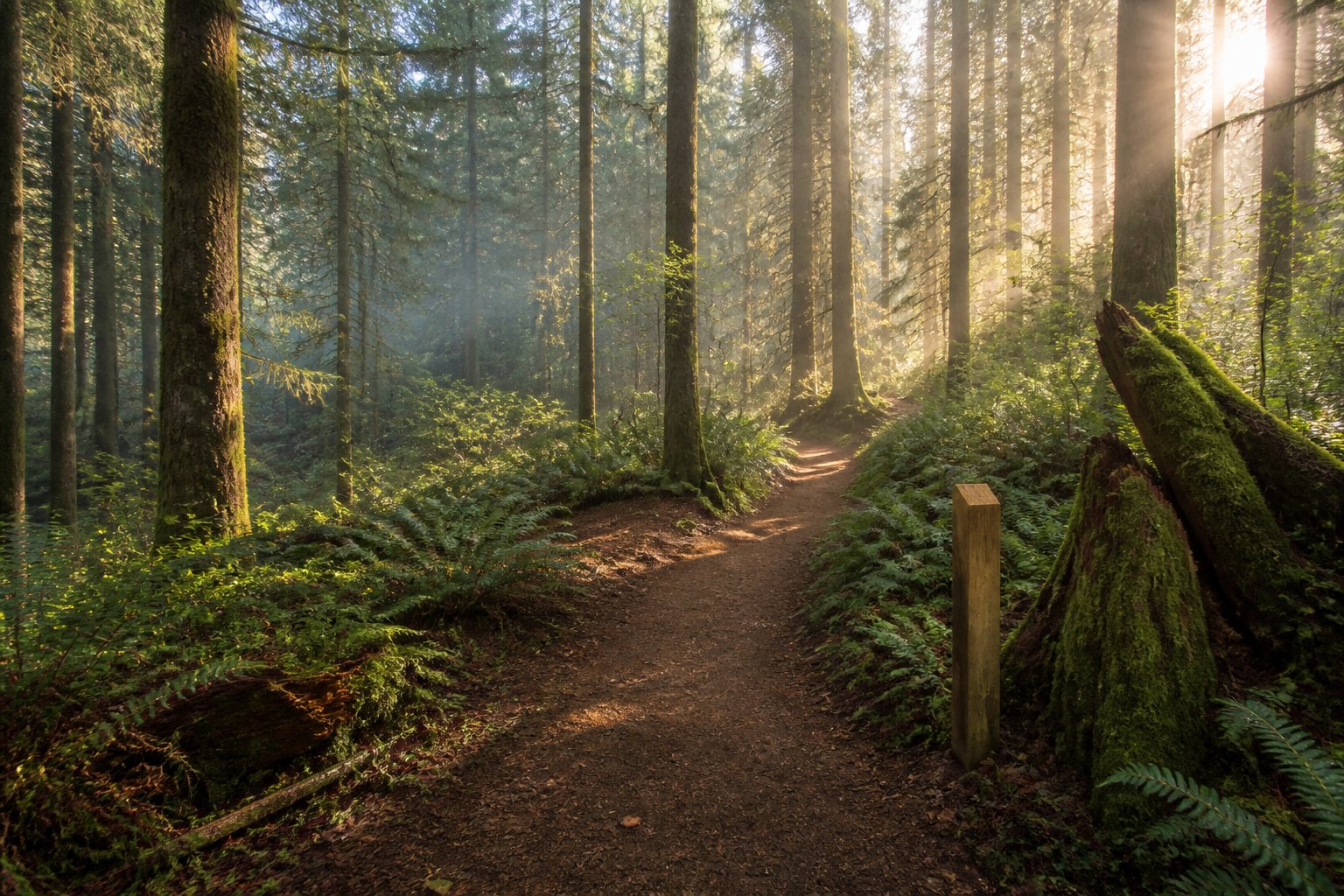
The Tillamook State Forest in coastal Oregon has 240 miles of multi-use trail. As of 2019, three full-time employees were responsible for maintaining it. By 2022, that number had dropped to one. The trail system, which serves around 600,000 visitors a year, was on track to lose roughly 30 percent of its usable mileage by 2027 simply because nobody was clearing blowdown after winter storms.
That projection is now off the table. Tillamook’s trail network came through the 2025 storm season in better shape than at any point in the past decade, and the reason has very little to do with state hiring. It has to do with a quiet rebuilding of trail stewardship as an organized civic activity, drawing on volunteers, land trusts, alumni groups, and a steady drip of small grants. The pattern is showing up across the western United States and parts of the Northeast, and it is rebuilding capacity in places where conventional agency budgets cannot.
What happened to trail crews
For most of the twentieth century, trail maintenance in national forests, state forests, and large county parks was done by paid crews. The Civilian Conservation Corps left behind a system of trails, shelters, and routes that required ongoing maintenance, and through the 1970s, agencies funded that work as a normal line item.
That funding eroded slowly through the 1980s and 1990s and then more sharply after the 2008 recession. By 2015, the U.S. Forest Service estimated a deferred maintenance backlog of roughly $300 million across its trail system. State agencies were in similar shape. Crew positions went unfilled. Equipment aged out. The fact that the trails remained passable was largely a function of legacy infrastructure and the patience of regular users who routed around problems.
The new approach is not, primarily, an attempt to refill those positions. State and federal budgets for trail crews remain tight. What has changed is the willingness of mid-sized nonprofits to organize the volunteer labor that does the actual work, and the willingness of agencies to formally partner with them.
The land trust pivot
One of the more interesting shifts has come from regional land trusts. For the past forty years, the dominant land trust model has been acquisition and easement protection. The work was about adding acres to the protected base. Maintenance, where it happened, was typically a function of paid agency staff once a property was conveyed to the public.
That model has been quietly evolving. A growing number of land trusts now run formal stewardship programs that include trail maintenance on properties they helped protect. The Trust for Public Land, the Trustees of Reservations in Massachusetts, the Mountains Restoration Trust in California, and several Pacific Northwest trusts have all expanded their stewardship staffing in the past three years. The model usually involves a small paid stewardship coordinator who organizes volunteers, plus formal partnerships with the receiving agency.
The economics make sense for both sides. The trust gains a measurable, photogenic stewardship program that helps with donor retention. The agency gains capacity it cannot fund directly. The volunteers get organized work days and a sense of contribution. And because the trust often retains a long-term relationship with the property, the partnership tends to outlast individual agency staff.
Alumni networks and the unexpected donor base
A more surprising contributor has been alumni networks – not of universities, but of conservation corps programs. Roughly 600,000 people have served in the modern conservation corps system since its quiet rebuilding in the late 1970s. Many of these alumni went on to non-conservation careers. A meaningful fraction of them have remained connected to the corps that trained them, and a smaller but significant fraction have become reliable donors.
Programs like the Northwest Youth Corps, the Vermont Youth Conservation Corps, and Conservation Legacy have, over the past five years, begun building structured alumni programs. The donations they generate are not large by foundation standards, but they are remarkably steady. A typical mid-sized corps now reports between $300,000 and $700,000 a year in alumni-driven revenue, much of it directed toward field crew operations.
That funding shows up as crew weeks in the field. A corps crew working on Tillamook’s trails costs roughly $4,500 a week. The alumni revenue at a typical Pacific Northwest corps is enough to fund 60 to 100 crew weeks a year. Spread across multiple agencies, that is real maintenance capacity.
Small grants doing disproportionate work
The third leg of the stool is the proliferation of small grants programs. The REI Cooperative Action Fund, the Conservation Alliance, individual state lottery-funded trail programs in Oregon and Washington, and several private family foundations have been writing grants in the $5,000 to $25,000 range with low overhead requirements. These grants do not fund permanent staff, but they fund tools, trailhead materials, transportation for volunteers, and the kind of equipment that allows a small crew to function.
The dollar amounts sound modest. They are. But the friction reduction is significant. A trail steward organization with reliable access to small grants does not have to write a major foundation application every year just to keep its truck running. The stability changes what is possible.
Why it’s working now
The cynical reading of all this is that volunteer-driven stewardship is just cover for ongoing agency disinvestment. There is some truth to that. State and federal trail budgets have not recovered, and there is little political appetite in most jurisdictions to fund the kind of professional crews that built the original system.
But the new arrangement is not simply a stopgap. It is a different model with its own strengths. The volunteer crews show up week after week, year after year, with continuity that agency staffing rarely matched even during better-funded periods. The land trust partnerships tend to keep institutional memory in place when individual agency staff rotate out. The small grants programs are less subject to political swings than line items in state budgets.
What the new model cannot do is the kind of large-scale rebuilding that requires heavy equipment, engineering, and long sustained crews. The replacement of a major bridge, the relocation of a trail away from a degraded watershed, the construction of new mileage – these still require agency resources, and the gap there is real. The volunteer-driven system is good at maintenance. It is not good at construction.
For most users of these trail systems, though, the difference is invisible. The blowdown gets cleared. The drainage gets cut. The waterbars hold. The trail is open. Behind that result is a remarkably loose coalition – a small nonprofit, a state agency liaison, a retired schoolteacher with a chainsaw, three college students on a fall break crew, and a donor who served in a conservation corps in 1989. It is not a system anyone would have designed from scratch. But it is, at the moment, working.

About Maya Bennett
Maya Bennett is an independent writer covering sustainability, climate innovation, outdoor culture, and the evolving relationship between technology and everyday life. Her work focuses on how modern communities adapt to environmental change through smarter design, conscious living, and emerging technologies. Over the past decade, Maya has contributed to publications and digital media projects focused on environmental awareness, travel, wellness, and future living trends. She is particularly interested in sustainable cities, regenerative tourism, clean technology, and the growing intersection between nature and innovation. When not writing, she spends time exploring coastal destinations, hiking trails, and conservation-focused communities around the world. Her reporting combines research-driven insights with a practical perspective on how environmental and technological shifts influence daily life.