What Shifting Rainfall Patterns Mean for Small-Scale Farmers
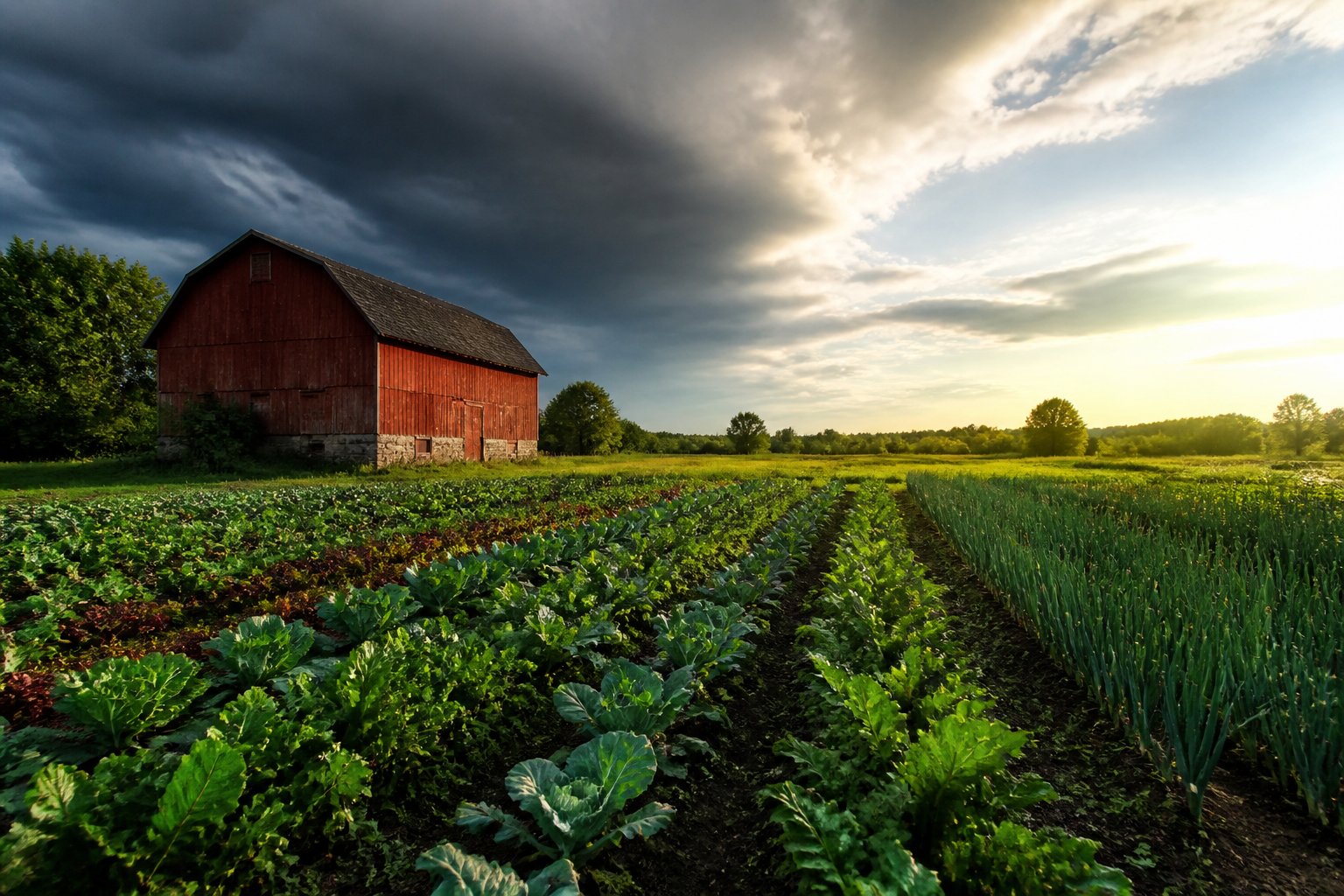
The Lankford family has farmed 90 acres in the Shenandoah Valley since 1894. Until about 2015, their planting calendar was, in practical terms, the same one their grandparents used. They put corn in the ground in late April, set tomatoes around Mother’s Day, and planted fall brassicas in late July. The calendar worked because the rain came, more or less, when it was supposed to.
That has stopped being reliable. The total annual rainfall in their valley has not changed dramatically – the long-term average is within five percent of where it was in 1990. What has changed is the distribution. The rain now comes in longer dry spells punctuated by more intense storms. A four-inch rain event in July used to be unusual. The Lankford farm got three of them in 2024 alone.
The problem is not the total, it’s the timing
Climate communication tends to focus on average changes. Average temperature, average rainfall, average growing season length. These averages are useful for some purposes, but they obscure what most farmers experience day to day. The actual problem for small-scale growers across much of the country is variance: the spread of rainfall events has widened, and the timing of those events has decoupled from the planting calendar.
Researchers at Penn State and Cornell have been tracking this pattern across the Mid-Atlantic and Northeast for the past decade. Their findings line up with what farmers describe anecdotally. The number of dry stretches longer than fourteen days during the growing season has roughly doubled since 1990 in many counties. The number of days per year with more than two inches of rain has also increased. The middle ground – steady, moderate rainfall – has shrunk.
That pattern is harder for small farms than for large industrial operations. A 1,000-acre corn operation can absorb a four-inch storm by accepting some yield loss across a small fraction of its fields. A 12-acre vegetable farm cannot. If the storm hits during the wrong week of tomato development, the entire crop can be compromised. The Lankfords lost most of their plum tomato planting in August 2024 not because of total rainfall but because of three days of standing water during root development.
Adaptations that are actually working
Small farms have responded with a set of changes that, taken individually, sound modest, and taken together, amount to a significant rebuild of how the work gets done. The first and most visible change is investment in subsurface drainage. Tile drainage has historically been associated with large grain operations, but a growing number of vegetable farms in the Mid-Atlantic have installed small-scale drain tile systems over the past five years. The Lankfords tiled fourteen acres in 2023. It is expensive – roughly $1,200 per acre – but it has made the fields workable during wet stretches that previously cost them weeks of access.
The second change is in cover cropping. Cover crops have been promoted for soil health for decades, but the recent uptake in the Shenandoah and similar valleys has been driven less by soil biology and more by water management. A well-established cover crop reduces surface runoff during heavy storms and improves infiltration during the dry stretches that follow. The Lankfords now plant a rye-vetch-radish mix on every acre that goes out of production, including some they previously left bare over winter.
The third change is harder to capture in a single statistic. It is a shift toward shorter-cycle, more diversified plantings. The Lankfords used to plant their tomatoes in three successions per season. They now plant in seven. Each succession is smaller, and the planting windows are tighter. The total volume of tomatoes harvested is similar to what it was a decade ago, but the risk of losing a single planting to a storm event is spread across many more small bets.
The Mountain West pattern is different
Out west, the same general pattern of increased variance is playing out differently. In the Mountain West, the dominant water source for most small farms is snowmelt, and the issue is less about storm intensity than about timing. Snowpack has been arriving later and melting faster. The peak runoff window has shifted by roughly two to three weeks earlier in the season in much of Colorado, Idaho, and northern Utah.
For irrigated small farms, this has meant rebuilding water-use plans around a compressed delivery window. A farm in the Gallatin Valley of Montana that historically had reliable irrigation water through mid-September now sees its allocation effectively end in early August. The standard response has been to plant earlier and to invest in storage – ponds, cisterns, sometimes lined tanks – that capture water during the high-flow weeks for use later.
Storage construction has its own difficulties. Permitting can be lengthy, and Western water law makes the legal status of stored water complicated. But the actual engineering is generally not the hard part. A 200,000-gallon farm pond, properly sized for a five-acre vegetable operation, can be excavated in a few days. The bottleneck is paperwork, not earthmoving.
The information layer
One change that often goes unnoticed in discussions of farm adaptation is the steady improvement in localized weather data. Most small farms in the United States now have access to forecast information at a granularity that simply did not exist twenty years ago. Hourly precipitation forecasts at the half-mile scale, soil moisture sensor networks, and integrated farm-management software have all become commonplace.
This information layer makes the rest of the adaptations work. Knowing that a major rain event is likely within 36 hours allows a farmer to hold off on harvesting, get a cover seeded, or move trays of starts under cover. The Lankfords run a small home-built monitoring system that reads off three soil moisture probes and pulls forecast data from the National Weather Service every fifteen minutes. The whole rig cost them about $400 and was put together by their son over a winter. It has changed how they sequence work during shoulder seasons.
What the next decade probably brings
Climate projections for the Mid-Atlantic and Mountain West are reasonably stable about one thing: variance will continue to increase. Total rainfall might shift slightly in either direction depending on the model, but the distribution of that rainfall is converging on a single picture – longer dry spells, more intense storms, more compressed snowmelt windows.
Small farms that have invested in the kinds of changes the Lankfords have made are likely to be more resilient through the next phase. The farms that have not adapted are likely to feel pressure. The economic margin in small-scale vegetable production has always been thin, and a single bad season under the new pattern can be enough to close a farm that would have weathered the old climate without much trouble.
The encouraging part of the story is that the adaptations are not exotic. They do not require breakthrough technology. They require capital, time, and a willingness to break with the calendar handed down from a generation that farmed in a different climate. Most of the farmers doing this work are not making heroic statements. They are doing what their grandparents would have done: paying attention to the land, talking to neighbors, and adjusting until the work makes sense again.

About Maya Bennett
Maya Bennett is an independent writer covering sustainability, climate innovation, outdoor culture, and the evolving relationship between technology and everyday life. Her work focuses on how modern communities adapt to environmental change through smarter design, conscious living, and emerging technologies. Over the past decade, Maya has contributed to publications and digital media projects focused on environmental awareness, travel, wellness, and future living trends. She is particularly interested in sustainable cities, regenerative tourism, clean technology, and the growing intersection between nature and innovation. When not writing, she spends time exploring coastal destinations, hiking trails, and conservation-focused communities around the world. Her reporting combines research-driven insights with a practical perspective on how environmental and technological shifts influence daily life.