How Coastal Towns Are Rethinking Waste Management for the Next Decade
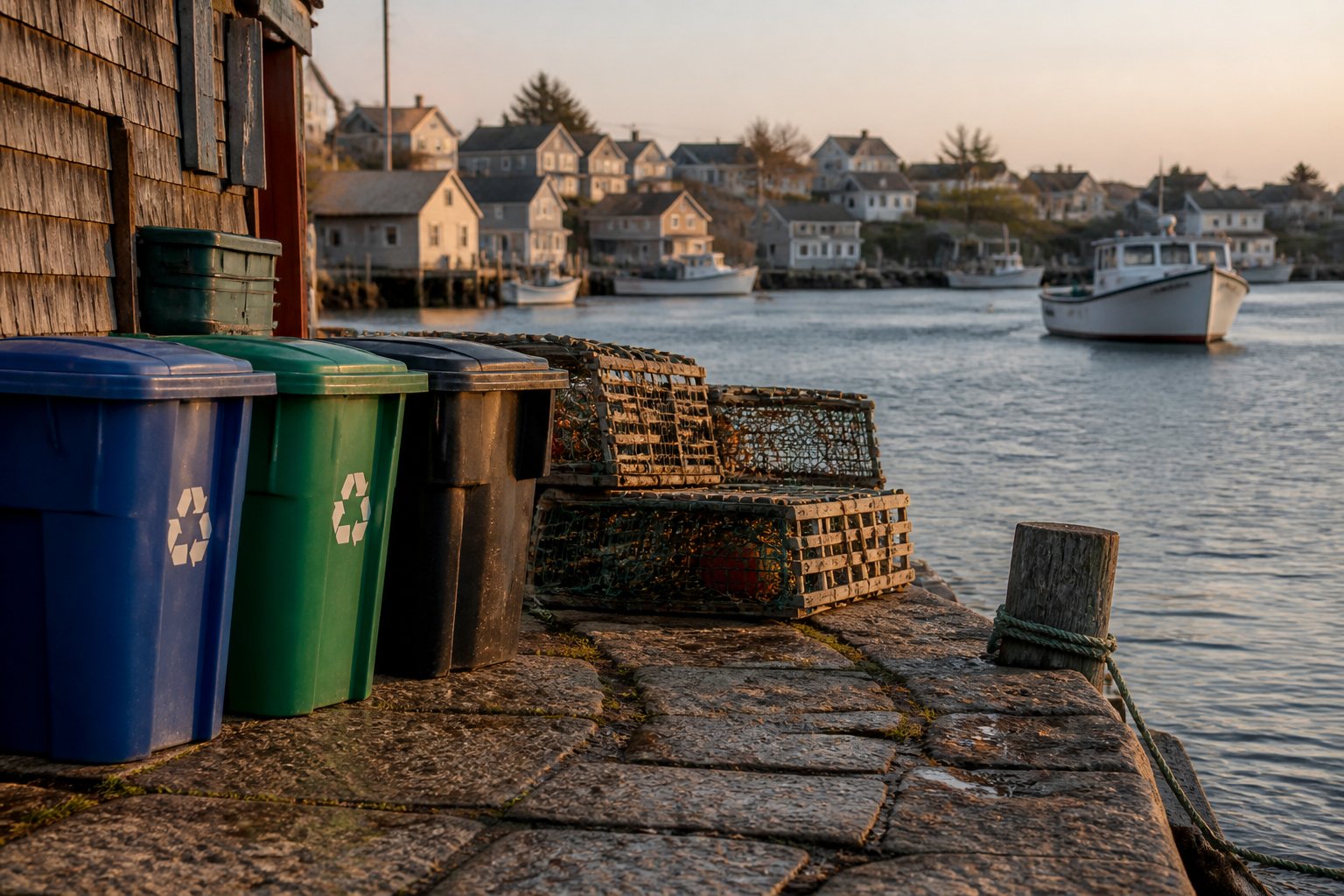
The fishing harbor in Stonington, Maine, used to receive a single garbage truck three mornings a week. The truck would crawl down Main Street, pause at the wharf, and haul off bins that held everything from spent bait packaging to broken lobster traps. That arrangement worked, more or less, for forty years. It does not work now.
Trap remnants alone – mostly plastic mesh and synthetic rope – pile up faster than the haulers can collect them, and the bait wrappers contain materials the regional facility no longer accepts. Stonington’s selectboard spent most of 2024 redesigning the system, and the new approach is now in its second full year. What they came up with looks less like garbage collection and more like a small logistics company.
The end of the single-truck era
For decades, the dominant model in coastal towns was a hub-and-spoke route. A municipal contractor drove a single packer truck through town, pulled bins from curbs, and brought everything to a transfer station. Recycling, if it happened at all, was a side stream. Maine’s regional MRFs accepted mixed paper and a narrow band of plastics, and the rest – including most of the trap netting – ended up in the landfill in Norridgewock.
Three things broke that model in quick succession. First, China’s ban on imported recyclables in 2018 collapsed the market for low-grade plastics. Second, Norridgewock’s landfill, which serves much of Maine’s coastal economy, has been operating under a phased closure plan since 2023. Third, the actual content of harbor waste shifted: more synthetic ropes, more single-use bait bags, more electronics from boats than anyone had budgeted for.
The town’s response was unusually practical. Instead of negotiating a new contract with the same hauler and accepting whatever rate landed, the selectboard mapped the actual waste streams. They counted bait bags by the pallet, weighed sample loads of trap mesh, and surveyed lobstermen about what materials came aboard each season. The result was a categorized inventory that no one in town had ever assembled before.
Six streams, not one
Stonington now runs six separate collection streams. Trap netting and ropes go to a fiber recycling outfit in New Hampshire that grinds the material into a feedstock for outdoor decking. Bait bags go to a regional pyrolysis pilot. Electronics ride a quarterly route to a state-licensed processor in Portland. Compostables – mostly food waste from the few year-round restaurants – go to a 40-acre farm fifteen miles inland. Standard recyclables follow the existing MRF route. What’s left, which is genuinely small, goes to the landfill.
The total operating cost is roughly 18 percent higher than the old single-truck contract, but the town avoids the rapidly escalating tipping fees at Norridgewock, and three of the streams now generate small offsetting payments. Net cost is essentially flat. The selectboard’s working assumption is that within five years, the streams will pay for the collection.
Other coastal towns have been watching closely. Yarmouth and Bar Harbor sent staff to observe the rollout. So did a delegation from Bandon, Oregon, where a similar harbor-waste problem has been building for the better part of a decade. None of these towns have adopted the Stonington model wholesale, but elements of it – the categorized inventory, the bait-bag stream, the contracted small haulers – are showing up in budgets along both coasts.
What makes it different
The shift in Stonington is less about new technology than about new logistics. The town isn’t waiting for a breakthrough in plastic recycling. It’s accepting that no single facility can handle the mix of materials a working harbor produces, and it’s routing each stream to wherever a viable buyer or processor exists. That sounds straightforward, and yet very few small towns have the staff time or the political appetite to do the underlying inventory work.
Sarah Conkling, who chairs the town’s solid waste advisory group, put it this way at a council meeting in February: “We stopped pretending we had a garbage problem. We had six garbage problems, and one of them turned out to be the easy one.” The framing has caught on. A handful of New England municipalities have hired part-time waste auditors over the past year, and at least two regional councils of government have proposed shared positions to do the same work at scale.
The economic logic gets sharper as state-level extended producer responsibility laws come into force. Maine’s EPR rules, which began collecting fees from packaging producers in late 2024, are starting to fund some of this categorization work directly. Massachusetts and Vermont are moving in similar directions. Towns that can already report on what they collect, by category, are in a much stronger position to recover those EPR funds than towns that send a mixed stream to the landfill and hope for the best.
The rope problem, specifically
The trap mesh is the most interesting case. Lobstermen in the Gulf of Maine cycle through millions of pounds of synthetic rope and netting each year. Until recently, the standard disposal route was to pile the spent material on the wharf and wait for it to either be hauled to the landfill or, more often, to drift onto someone else’s property. Stonington’s collection program, run jointly with a small outfit called Coastal Fiber Recovery, has diverted just under 90,000 pounds of rope in its first 18 months.
The recovered fiber is not high quality. It can’t compete with virgin polypropylene for marine uses. But the deck-board market is forgiving, and the price has remained stable enough that Coastal Fiber Recovery has been able to pay a small per-pound rate back to the town. It is not a windfall. It pays for one of the three drivers on the trap-recovery route. But it is the first time most lobstermen in Stonington can remember being paid – even indirectly – for getting rid of something.
Replication versus invention
None of the moving parts in Stonington’s system are new. Pyrolysis pilots for marine plastics have been running on the Pacific Northwest coast since 2019. Trap-recovery programs exist in Nova Scotia and on the Outer Banks. Categorized municipal waste inventories have been a feature of Scandinavian planning for two decades. What’s new is the assembly: a working-class New England fishing town stitching the components together inside a normal municipal budget.
That assembly is, in the end, what other towns are coming to see. The hard part is not the engineering. It is the willingness to break apart a single contract that almost worked into six smaller arrangements that, taken together, actually work. Selectboard members in Bandon were candid about this in their March visit. “We’ve been writing one big RFP for thirty years,” one of them said in the wharf parking lot. “Maybe the answer is six smaller ones.”
If the next decade of coastal waste management plays out the way Stonington’s planners expect, the visible signs will be modest. Fewer mountains of rope on working wharves. A second small hauler driving a different route. A line on the town report about pyrolysis revenue. The deeper change, though, is structural. Coastal towns are starting to treat waste the way they treat their landings: as a set of distinct materials, each with its own market, each worth tracking. That is a quieter revolution than most of what gets called sustainability, and it is probably more durable.

About Maya Bennett
Maya Bennett is an independent writer covering sustainability, climate innovation, outdoor culture, and the evolving relationship between technology and everyday life. Her work focuses on how modern communities adapt to environmental change through smarter design, conscious living, and emerging technologies. Over the past decade, Maya has contributed to publications and digital media projects focused on environmental awareness, travel, wellness, and future living trends. She is particularly interested in sustainable cities, regenerative tourism, clean technology, and the growing intersection between nature and innovation. When not writing, she spends time exploring coastal destinations, hiking trails, and conservation-focused communities around the world. Her reporting combines research-driven insights with a practical perspective on how environmental and technological shifts influence daily life.