Microgrids Are Powering Remote Communities in Surprising Ways
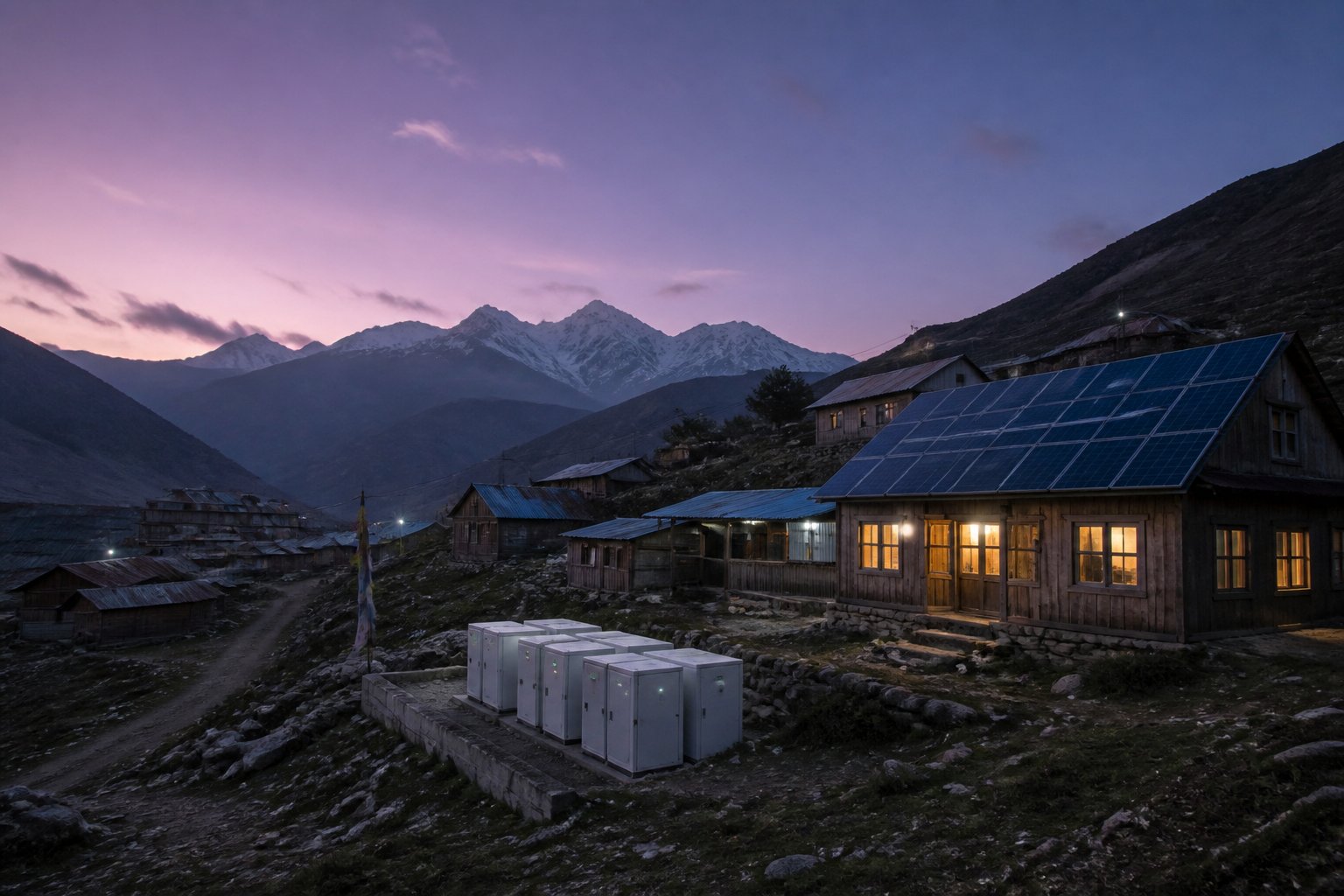
The village of Aklavik sits about 30 miles northwest of the Mackenzie River delta in Canada’s Northwest Territories, well above the Arctic Circle. For most of its modern history, the village has been powered by diesel generators trucked in along ice roads during the brief winter months when overland transport is possible. The diesel was expensive, the supply was uncertain, and the carbon footprint was substantial for a community of fewer than 600 people.
Aklavik now runs primarily on solar power, with diesel as backup, through a microgrid that became operational in 2023. The technical details of the installation are not unusual: roughly 1.2 megawatts of solar capacity, three megawatt-hours of battery storage, an inverter system that can shed and accept load smoothly, and the existing diesel generators kept on standby. What is unusual is the ownership and operations structure. The system is owned by the community itself, through a hamlet-level corporation, and operated by a partnership of community members and an indigenous-owned utility services company based in Inuvik.
The Aklavik installation is part of a broader pattern that has been quietly building over the past five years. Microgrid technology, which had been technically mature but economically marginal for community-scale applications, has crossed into a different cost regime. The result is that remote communities that were previously dependent on imported diesel are increasingly able to consider self-managed renewable power, and the technical and economic case has stopped being the limiting factor.
What changed
The standard explanation for why microgrids have become economically viable focuses on solar panel costs, which have fallen by more than 90 percent over the past 15 years. That story is true but incomplete. The more important changes for community-scale microgrids have been in three other technologies: battery storage, inverter sophistication, and remote monitoring.
Battery storage costs have fallen more sharply than solar over the past five years, and the chemistries available for stationary storage have improved. The lithium iron phosphate batteries that dominate the current generation of microgrid installations are more durable, more thermally stable, and less expensive per kilowatt-hour than the lithium-cobalt batteries that were standard a decade ago. The replacement of older battery chemistries has also reduced the safety concerns that made some communities reluctant to adopt large battery installations near residential areas.
Inverter sophistication is the less-publicized improvement. A modern grid-forming inverter can do things that earlier generations of inverters could not: it can hold a stable voltage and frequency on a small grid without a synchronous generator, it can switch between solar, battery, and backup sources smoothly enough that residents do not notice, and it can integrate with diverse renewable sources without requiring custom engineering. The result is that a small community microgrid can be assembled from off-the-shelf components in a way that was not practical even a few years ago.
Remote monitoring is what makes the operations side work. A microgrid in a community of 600 people cannot economically support a full-time technical staff. What it can support is a few trained local operators who handle routine work, supported by remote technical staff who can monitor system performance, diagnose problems, and dispatch repairs when needed. The remote monitoring tools have become reliable enough and inexpensive enough that this hybrid operations model is now standard.
The ownership shift
The ownership pattern that has emerged in the most successful community microgrid installations is what some researchers are starting to call “community-utility partnership” rather than either pure community ownership or conventional utility ownership. The community owns the physical infrastructure, often through a community corporation or cooperative. The day-to-day operations are managed by local staff. The technical support, regulatory compliance, and grid services are provided by a utility or utility-like organization, often on a contractual basis.
This model has several advantages over pure community ownership, which has historically struggled with the technical complexity of operating a grid, and over pure utility ownership, which has historically struggled with the financial economics of serving small remote communities. The hybrid model retains the technical capacity of a utility while keeping the economic value of the installation within the community.
Several jurisdictions have built regulatory frameworks that support this hybrid model. The Northwest Territories has developed a community energy framework that explicitly recognizes community-owned generation and provides a clear path for community microgrids to interconnect with regional infrastructure where it exists. Alaska has a similar framework through its Power Cost Equalization program. Several Pacific island nations and Caribbean territories have built comparable structures.
The economics from the inside
The financial logic of a community microgrid is different from the financial logic of a utility-scale renewable installation. The microgrid does not have to compete with bulk power markets. It only has to compete with the cost of the displaced diesel.
Diesel power in remote northern communities typically costs between 50 cents and one dollar per kilowatt-hour, depending on transport distance and fuel prices. The levelized cost of energy from a properly sized community solar-battery system is generally well below that, often by a factor of three or four. The economic case is therefore not about competing with cheap grid power. It is about replacing very expensive diesel power, and the math is favorable enough that the financing case can be made without subsidy.
What still requires subsidy or grant funding is typically the up-front capital cost, which is large relative to community resources. Most of the successful installations have used a combination of federal infrastructure funding, provincial or territorial programs, indigenous economic development funds, and in some cases foundation grants. The financing structures vary, but the common element is that the community is not expected to capitalize the installation from its own resources, while the operating costs are covered through electricity tariffs that residents and businesses pay.
What goes wrong
The microgrid projects that have struggled tend to share a few characteristics. The most common problem is undersizing of the storage relative to the renewable generation, which leaves the diesel backup running more than expected and undermines the cost case. The second is inadequate community operator training, which makes the system overly dependent on remote technical support and creates failure modes when that support is delayed.
The third problem is harder to fix: maintenance funding that does not match the actual long-term needs of the system. Solar panels and batteries do not require a lot of maintenance, but they do require some, and the inverters in particular need periodic replacement that is not always budgeted into the initial financing. Communities that have built strong long-term operating reserves into their tariff structure have generally fared better than communities that have priced electricity at the marginal cost of operation without provisioning for capital renewal.
The broader pattern
The community microgrid model is not going to displace conventional utility power in most of the world. It is, however, becoming the default for remote communities that have historically relied on diesel, and the implications of that shift are substantial. Hundreds of communities in the Canadian and Alaskan north, in the Pacific islands, in remote parts of South America, and in indigenous communities across multiple countries are in the early or middle stages of similar transitions.
The pace of the transition is constrained more by financing capacity and skilled technical support than by technology. The technology works. The financing case works at the project level. What slows the rollout is the institutional work of structuring partnerships, assembling capital stacks, and building the operating capacity in each community.
For most residents of these communities, the practical experience of a working microgrid is unspectacular. The lights come on when the switch is flipped. The bills are lower than they used to be. The diesel trucks come less often. The system runs in the background. What is happening underneath that quiet experience is the beginning of a different model for how electricity gets supplied at the small scale, one that does not depend on long-distance transmission, central generation, or imported fuel. That is a meaningful structural shift, and the communities at the leading edge of it are demonstrating that the model works.

About Maya Bennett
Maya Bennett is an independent writer covering sustainability, climate innovation, outdoor culture, and the evolving relationship between technology and everyday life. Her work focuses on how modern communities adapt to environmental change through smarter design, conscious living, and emerging technologies. Over the past decade, Maya has contributed to publications and digital media projects focused on environmental awareness, travel, wellness, and future living trends. She is particularly interested in sustainable cities, regenerative tourism, clean technology, and the growing intersection between nature and innovation. When not writing, she spends time exploring coastal destinations, hiking trails, and conservation-focused communities around the world. Her reporting combines research-driven insights with a practical perspective on how environmental and technological shifts influence daily life.