Urban Wetlands Are Returning, and They’re Working Harder Than We Expected
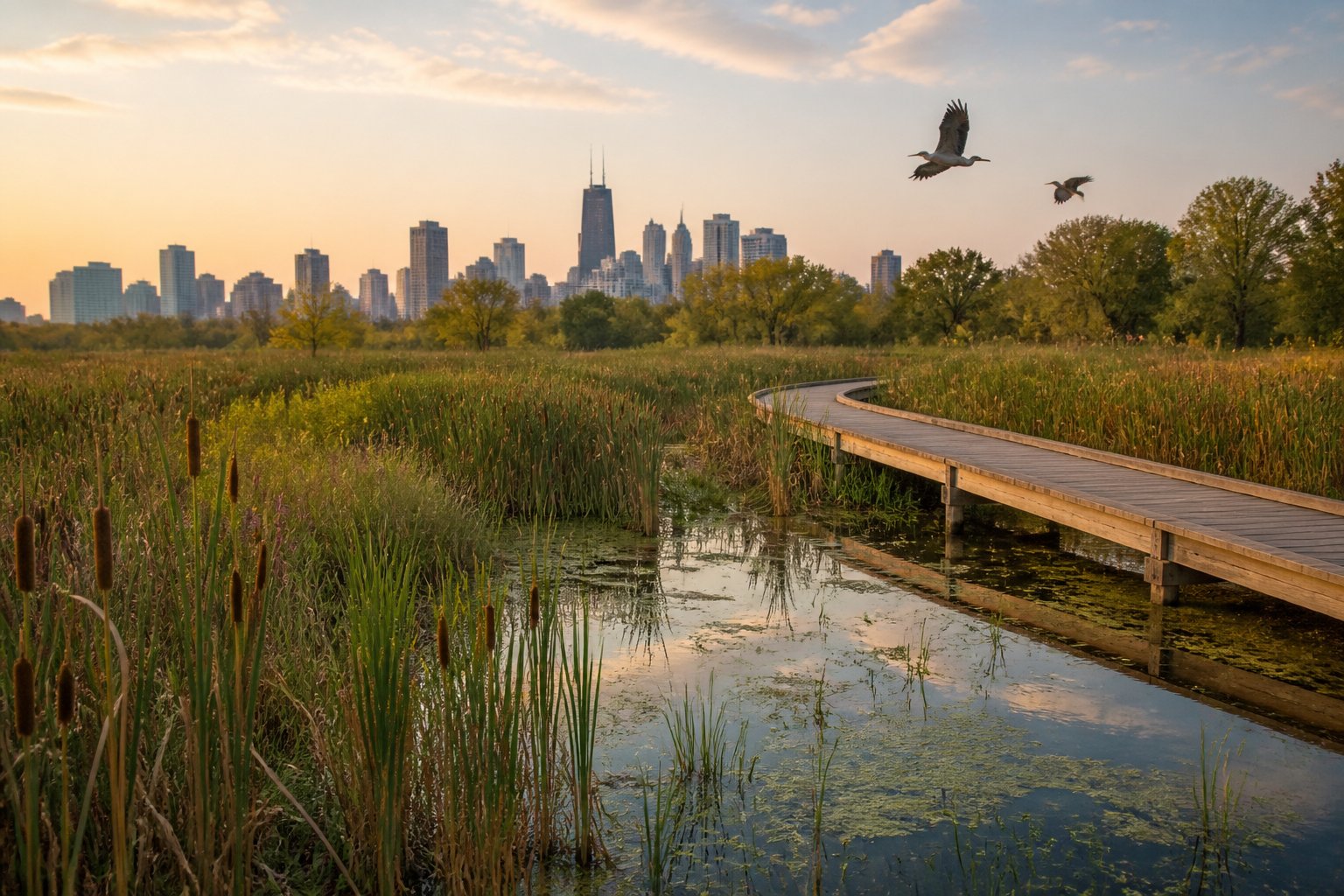
The Mill Creek wetland complex in Cincinnati used to be a parking lot. Before that, it was a buried storm sewer carrying a stream that had been engineered out of sight in the 1880s. The site sat unused for most of the 1990s, was briefly considered for a big-box retail development in 2003, and finally became the subject of a wetland restoration proposal in 2012. The proposal took six years to fund, two years to permit, and eighteen months to construct. The site has been operating as a functioning wetland since 2022.
By any reasonable measure, the project has outperformed its predicted benefits. Stormwater detention capacity has exceeded design specifications. Water quality entering the Mill Creek main stem has improved measurably during heavy rain events. Bird species counts have climbed faster than the restoration ecologists expected. Adjacent property values have risen modestly. None of this is unusual. It is, increasingly, what restored urban wetlands do.
Why cities removed wetlands
For most of the past two centuries, urban wetlands were treated as problems to be solved. They harbored mosquitoes, flooded basements, complicated road construction, and were thought to spread disease. Through the late nineteenth and most of the twentieth century, American cities filled or piped their wetlands at remarkable speed. Boston, Chicago, New Orleans, and almost every other major U.S. city eliminated a substantial fraction of their original wetland coverage by 1970.
The downstream consequences were not initially understood. Urban flooding got worse as the natural storage capacity that wetlands provided disappeared. Surface water quality declined as the filtration function was lost. Heat islands intensified as the cooling effect of standing water and emergent vegetation went away. Bird and amphibian populations crashed in city neighborhoods where they had been abundant for centuries.
By the time these consequences became clear, the original wetlands had been built over with infrastructure that would be expensive to remove. The Clean Water Act of 1972 slowed the elimination of remaining wetlands but did little to encourage restoration. For most of the 1980s and 1990s, urban wetland restoration was rare, expensive, and politically difficult.
The cost case has changed
The shift over the past fifteen years has been driven less by environmental advocacy than by infrastructure economics. Cities facing aging stormwater systems and tightening regulatory requirements began comparing the cost of conventional gray infrastructure – larger pipes, deeper retention basins, additional treatment capacity – against the cost of restoring or constructing wetland systems that performed equivalent functions.
The comparison has consistently favored the wetland approach for a meaningful range of applications. A restored wetland sized to handle 50 acre-feet of stormwater detention typically costs significantly less than the equivalent engineered alternative, particularly when the engineered alternative requires significant subsurface construction in dense urban areas. The wetland also provides ancillary benefits that the engineered alternative cannot: water quality improvement, habitat, cooling, recreation, and aesthetic value.
The benefit-cost ratio gets even more favorable when long-term maintenance is included. A properly designed urban wetland requires relatively modest annual maintenance once vegetation is established. A subsurface detention system, by contrast, requires inspection, sediment removal, and periodic infrastructure repair on an indefinite basis. The total cost of ownership over fifty years often differs by an order of magnitude.
What restored urban wetlands actually do
The technical functions of urban wetlands are reasonably well-characterized. Sediment settling removes a substantial fraction of suspended solids from stormwater before the water reaches the receiving stream. Biological uptake by emergent vegetation removes nutrients, particularly nitrogen and phosphorus, that would otherwise drive downstream algae blooms. Temporary surface storage attenuates flood peaks and extends the time over which water enters the drainage system.
The biological functions are equally important. A restored urban wetland of even modest size tends to attract a remarkable diversity of bird species, amphibians, and aquatic invertebrates within a few years of establishment. The species mix reflects what is locally available, which means the recovery is faster in cities with intact corridors to nearby natural areas and slower in cities with fragmented green infrastructure.
What has surprised many of the restoration ecologists working on these projects is the speed of the recovery. The conventional assumption was that decades of sediment contamination, hydrologic modification, and loss of seed banks would slow the return of functional ecosystems. In practice, well-designed restorations have generally exceeded the expected timeline for ecological function. The reasons are not fully understood, but they appear to involve the resilience of native plant communities, the willingness of bird populations to colonize new habitat quickly, and the speed at which invertebrate communities establish in shallow water.
The political dynamics
Building an urban wetland is, in most cities, more politically complicated than building gray infrastructure. Conventional stormwater projects can be funded through utility revenue and built largely within existing rights-of-way. Wetlands generally require land acquisition or repurposing, multi-agency coordination, and public engagement on land use questions that gray infrastructure does not raise.
The political work tends to be easier when the wetland is sited on land that no one is currently using for something else: brownfields, vacant industrial sites, marginal parkland. The Mill Creek project succeeded partly because the parking lot it replaced was not generating significant revenue and was not part of anyone’s mental map of the neighborhood. Projects that have tried to displace functioning land uses have generally struggled, regardless of their technical merits.
Where urban wetlands have been most successful is in cities that have integrated them into longer-term comprehensive plans rather than treating them as isolated projects. Philadelphia, Portland, and Milwaukee have all developed multi-decade green infrastructure plans that identify candidate sites years in advance, allowing land acquisition, funding, and community engagement to proceed on a sustainable timeline.
The next phase
The most likely direction over the next decade is gradual expansion of urban wetland coverage in cities that have committed to the model, slower adoption in cities that are still on the gray infrastructure track, and continued refinement of the design and monitoring tools. The technical and economic case is increasingly settled. What remains is the slow institutional work of land acquisition, permitting, and community engagement that any large infrastructure shift requires.
For residents, the visible signs are modest and cumulative. A few more sites that used to be vacant become small parks with marsh grasses. A creek that used to flood predictably starts to flood less often. A bird that had not been seen in the neighborhood for fifty years shows up at a feeder. The changes are not dramatic in any single year, and they are not always recognized as the result of deliberate restoration work. But the underlying transformation is real, and the cities that are leading on it appear to be saving substantial money in the process.
The lesson from Mill Creek and its peers is that the ecological function of urban wetlands is more recoverable than most engineers assumed even twenty years ago. A buried stream brought back to the surface, surrounded by native vegetation, and given a chance to settle, will start doing the work that wetlands do. The work is quieter than most infrastructure. It is also, increasingly, what cities are choosing.

About Maya Bennett
Maya Bennett is an independent writer covering sustainability, climate innovation, outdoor culture, and the evolving relationship between technology and everyday life. Her work focuses on how modern communities adapt to environmental change through smarter design, conscious living, and emerging technologies. Over the past decade, Maya has contributed to publications and digital media projects focused on environmental awareness, travel, wellness, and future living trends. She is particularly interested in sustainable cities, regenerative tourism, clean technology, and the growing intersection between nature and innovation. When not writing, she spends time exploring coastal destinations, hiking trails, and conservation-focused communities around the world. Her reporting combines research-driven insights with a practical perspective on how environmental and technological shifts influence daily life.