The New Generation of Refillable Packaging Quietly Winning Grocery Aisles
In 1992, the city of Hamburg ran a refillable packaging pilot in three of its largest supermarket chains. Shoppers brought their own containers, filled them at bulk stations, paid by weight, and went home. The trial was reasonably well-publicized and broadly popular with the customers who tried it. It also lost a substantial amount of money for the chains involved, and within four years, every station had been removed.
What killed the Hamburg pilot was not customer enthusiasm. It was logistics. The labor cost of cleaning containers, maintaining the dispensers, handling spillage, and managing the cross-contamination risk between bulk products was several times higher than the savings on packaging. The pilot was a good idea executed with bad infrastructure.
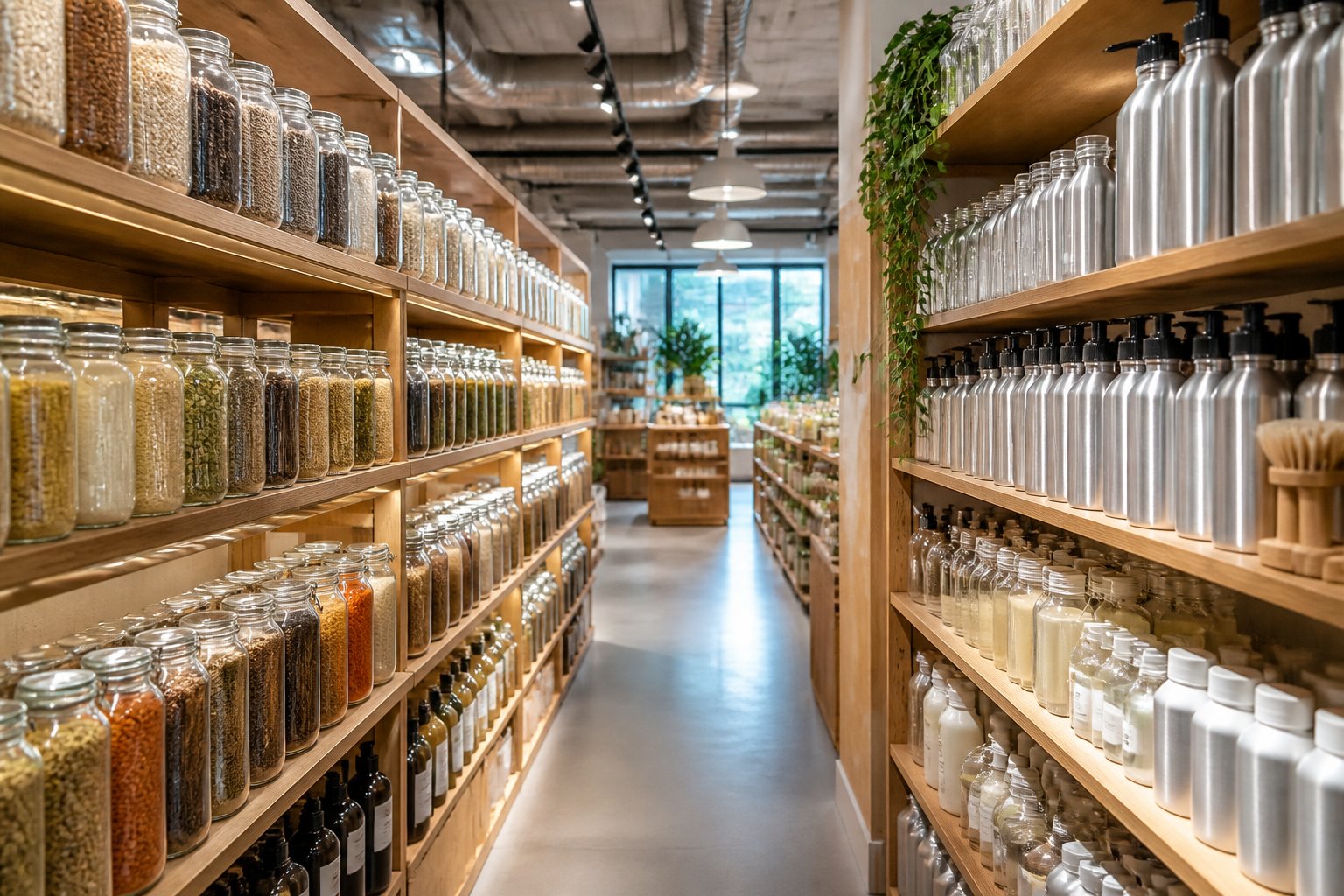
The current generation of refillable packaging looks superficially similar – glass bottles, aluminum tins, customer-supplied containers at some stations – but the underlying systems are not the same. The labor problems that killed the 1990s versions have been mostly engineered out, and the unit economics finally make sense.
What’s different this time
The most important change is that the dominant model is no longer customer-supplied containers. It is closed-loop reusable packaging owned by the retailer or manufacturer. Customers buy a bottle of laundry detergent the way they always have. The bottle is glass or thick-walled aluminum. When it is empty, they return it to the store – often through a bin near the entrance, sometimes through a curbside pickup – and the bottle goes back through a centralized cleaning facility for reuse.
The customer experience is almost identical to single-use packaging. There is no scooping, no measuring, no pouring from a bulk hopper into a personal jar. The cognitive load is essentially zero. The labor cost for the retailer is small, because the cleaning happens centrally rather than at each store. And the deposits create a strong return incentive without requiring the customer to think about it.
The second change is in the underlying tracking infrastructure. The newer systems use QR codes, RFID tags, or both, allowing each bottle to be tracked through its lifecycle. A bottle that has been refilled forty times can be retired before failure. A bottle that has been contaminated can be flagged and removed from the pool. The data on actual reuse rates can be used to optimize routing, deposit pricing, and bottle design. None of this was practical in the 1990s. It is straightforward now.
Where the systems are working
The European market has moved fastest. Loop, the reuse system that started as a high-end pilot in France in 2019, has now expanded to mainstream supermarket chains in France, Germany, the United Kingdom, and parts of Belgium and the Netherlands. The product range has shifted significantly over time. The early Loop offerings were dominated by premium brands – designer ice cream, niche personal care – but the current product mix is much closer to ordinary household consumption: pasta sauce, laundry detergent, hand soap, breakfast cereals, cleaning products.
The unit economics now work because the system has reached enough scale that the per-cycle cost of cleaning, transport, and sorting has fallen below the cost of producing equivalent new packaging. The exact crossover point varies by product category. Glass bottles for thick liquids hit the crossover at fewer reuse cycles than thin-walled aluminum cans. But across most product categories, the math has tipped.
The United States has been slower to adopt the model, but several chains have begun rolling it out. Whole Foods, Erewhon, and a handful of regional grocers in the Pacific Northwest and Northeast have run limited refillable lines for the past two to three years. Walmart announced a more aggressive pilot in late 2024 across selected stores in the upper Midwest. The Walmart pilot is the one most logistics observers are watching closely, because it represents the first attempt to push reuse into a true mass-market price point.
The packaging itself
Designing a bottle for reuse is a different engineering problem from designing one for single use. The wall thickness has to be higher. The closures have to survive industrial washing. The labels have to be removable without leaving residue. The geometry has to accommodate efficient stacking in transit and easy handling on automated lines.
Most of the bottles now in circulation have been redesigned specifically for reuse, rather than adapted from existing molds. Several glass manufacturers in Europe and the U.S. have invested in new lines optimized for reusable bottle production. The resulting bottles are heavier than single-use versions, which adds slightly to transport emissions per unit, but the trade-off is favorable as long as each bottle is reused more than five or six times. Most of the systems now in operation are running well above that threshold.
One subtle but consequential design choice has been the move toward standardized formats. Earlier reuse systems often used brand-specific bottle shapes, which complicated cleaning and sorting. The newer generation increasingly relies on a small number of standardized form factors that can be processed on the same line regardless of brand. Standardization reduces capital costs for cleaning facilities and makes regional infrastructure easier to scale.
The deposits question
The deposit structure is one of the more underappreciated aspects of these systems. Deposits work as a return incentive only if they are large enough to matter and small enough that customers will actually pay them. The current European systems typically charge deposits in the range of 30 to 60 euro cents per container. That is high enough to drive return behavior – published return rates run above 85 percent for most product categories – and low enough that it does not deter purchase.
The U.S. picture is more complicated. State bottle bills, where they exist, have set deposit levels for single-use containers that are often too low to drive return behavior. The reuse systems entering the U.S. market have generally set their own deposit levels independent of state bottle bills, which creates some legal and operational complexity but allows the systems to function. Whether this patchwork is sustainable as the systems scale is an open question.
What this means for the next few years
The trajectory for refillable packaging is no longer in serious doubt. The systems work. The unit economics make sense at scale. The customer experience is acceptable. The remaining questions are about pace of rollout, geographic coverage, and which categories cross over first.
For most consumers, the visible change over the next few years will be the gradual appearance of refillable lines for an expanding range of products. Detergents, cleaning products, and condiments are likely to lead. Fresh dairy is harder, both because of shorter shelf life and tighter food safety requirements, but the systems have started working out those constraints. Pet food, breakfast cereals, and household paper products are likely to follow.
What will not change, on the current trajectory, is the visible look of the grocery aisle. The bottles will look mostly like bottles. The aisles will look mostly like aisles. The big difference will be the small bin near the entrance and the slow rise of a culture in which empty containers go back where they came from. That is a quieter shift than most sustainability stories. It is probably the one with the largest cumulative effect.

About Maya Bennett
Maya Bennett is an independent writer covering sustainability, climate innovation, outdoor culture, and the evolving relationship between technology and everyday life. Her work focuses on how modern communities adapt to environmental change through smarter design, conscious living, and emerging technologies. Over the past decade, Maya has contributed to publications and digital media projects focused on environmental awareness, travel, wellness, and future living trends. She is particularly interested in sustainable cities, regenerative tourism, clean technology, and the growing intersection between nature and innovation. When not writing, she spends time exploring coastal destinations, hiking trails, and conservation-focused communities around the world. Her reporting combines research-driven insights with a practical perspective on how environmental and technological shifts influence daily life.