Co-Housing in 2026: What’s Actually Working and What Isn’t
The Danish co-housing movement turned fifty in 2022. The first formal co-housing development in Denmark, Sættedammen, was founded in 1972 with explicit principles about shared facilities, intentional community design, and member-led governance. Over the next thirty years, the model spread slowly across northern Europe, into North America, and to a smaller extent into other regions. Adoption was steady but modest. By 2010, co-housing remained, in most countries, a niche housing model occupied by a small but committed minority of residents.
The past decade has been different. Co-housing has grown more rapidly in the United States, Canada, and several European countries since roughly 2015 than in any previous period. The drivers have been a combination of housing affordability pressures, demographic shifts, climate concerns, and a generational interest in alternative housing arrangements that the model has historically served. The result is enough operational experience across enough developments that the lessons from the boom years are now reasonably well-characterized.
What co-housing actually is
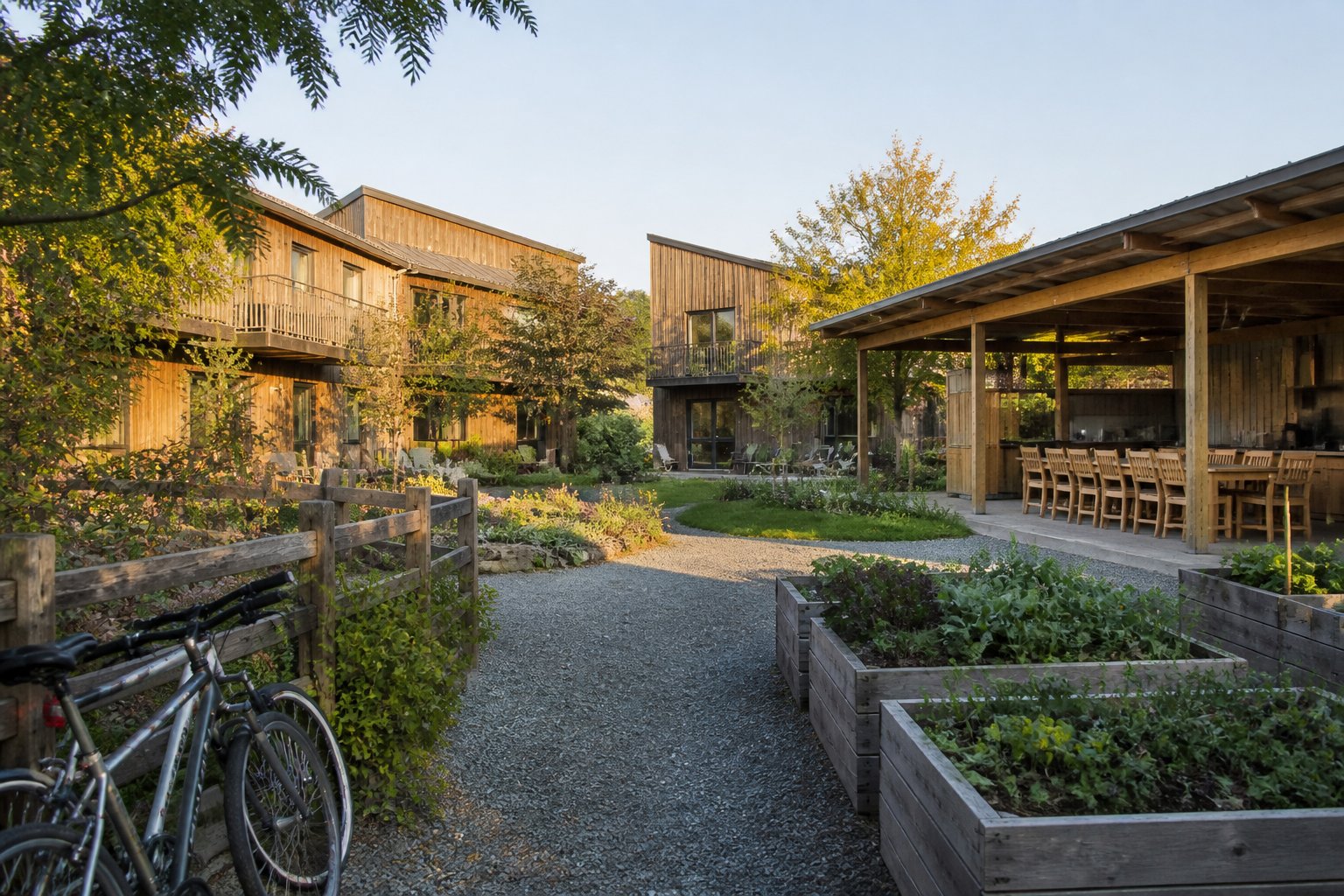
Co-housing has a fairly specific definition that gets blurred in popular discussion. A formal co-housing development has private dwelling units, typically self-contained, complemented by significant shared facilities: a common house with a kitchen, dining space, and community rooms; shared outdoor space; often shared workshops, guest rooms, and laundry facilities. The shared facilities are owned in common by the residents, and the community is typically self-governed through some form of consensus-based decision making.
The key distinction from other forms of intentional community is that co-housing residents maintain full economic and personal independence in their private units. They cook their own meals if they want, although most communities have regular shared meals. They have their own kitchens, their own bedrooms, their own privacy. The shared element is layered on top of conventional housing rather than replacing it.
This is also what distinguishes co-housing from communes, group houses, and other shared living arrangements that pool more of daily life. Co-housing is closer to a deliberately designed neighborhood than to a household. The design intent is to make low-stakes daily interaction with neighbors easy without requiring high-stakes shared decision making about money, food, or personal life.
What’s working
The communities that have established themselves well over the past decade share several characteristics. First, the design of the physical space matters significantly. Communities where private units face onto pedestrian paths and common areas, rather than onto parking lots, consistently produce more spontaneous daily interaction. Communities with well-designed common houses that include practical amenities residents actually need – good kitchens, comfortable workspaces, guest rooms – see more use of shared facilities than communities where the common house was designed as an afterthought.
Second, the governance model matters. The communities that have functioned over multiple decades have generally developed clear, documented decision-making processes that handle routine matters efficiently and reserve consensus-based discussion for the relatively few decisions that warrant it. Communities that try to apply consensus to everything tend to wear out their members within a few years. Communities that delegate too much to formal management tend to lose the resident engagement that makes the model work.
Third, the demographic mix matters. Co-housing communities that span generations – young families, middle-aged adults, retirees – tend to be more resilient than communities clustered in a single life stage. Multi-generational communities have a wider range of skills available for community work, more flexibility in care arrangements, and more durable membership over time. Communities composed entirely of one age cohort tend to age together and run into specific challenges in later decades.
What hasn’t worked
The struggles of co-housing communities have also clarified. The most common point of failure is financial. Co-housing developments in markets with rising housing prices have generally had to charge market rates or near-market rates for units in order to finance construction. This has limited the demographic diversity of who can afford to join, and has in some markets produced communities that look financially uniform in ways that limit the social benefits the model is supposed to provide.
The second common failure mode is sustained engagement. Co-housing requires more participation from residents than conventional housing does. Communities work best when most residents participate actively in shared meals, work parties, governance meetings, and decision-making processes. Communities where participation drops below a certain threshold tend to slowly hollow out: the shared spaces get less use, the governance gets more contentious, the social fabric thins. Several communities founded in the 2000s have struggled with this over time as the energy of their founding cohort has waned and newer residents have not picked up the same level of engagement.
The third failure mode is conflict resolution. Co-housing communities are not free of interpersonal conflict, and the model puts more stress on individual relationships than conventional neighborhoods do, because residents interact more frequently and have more shared decisions to make. Communities that have invested in formal conflict resolution training, that have developed clear processes for handling disputes, and that have norms around addressing tensions directly tend to fare better than communities that hope conflict will not arise.
The financial picture in 2026
One of the more interesting developments in the past few years has been the emergence of financing models that make co-housing more accessible across a wider income range. Conventional co-housing has been built almost entirely on standard mortgage financing, with all the affordability constraints that implies. Recent projects have experimented with mixed-income models, with land trust structures that separate land ownership from unit ownership, and with cooperative financing that distributes risk and equity differently than conventional condominium ownership.
Several recent co-housing developments in Vermont, Oregon, and parts of the upper Midwest have incorporated 20 to 40 percent of units financed through affordability mechanisms, including limited-equity cooperative shares, community land trust ground leases, and below-market financing for income-qualified residents. The early evidence from these projects is that the social outcomes are stronger when the financial diversity is wider, although the projects are more complex to develop and finance than conventional co-housing.
The shape of the next phase
The most likely trajectory for co-housing over the next decade is continued steady growth, with the model becoming more familiar in mainstream housing discourse even though it remains a small fraction of total housing production. Several states and provinces have begun considering housing policy adjustments that would make co-housing easier to develop, including zoning changes that accommodate shared facilities and clarifications around cooperative and condominium law that reduce the legal complexity of formation.
What is unlikely to change is that co-housing remains a model that requires sustained participation from its residents to function well. The benefits – reduced loneliness, shared resources, intergenerational community, reduced per-household environmental footprint – are real and increasingly documented. They are not free. They require time, attention, and willingness to engage with neighbors in ways that conventional housing does not require.
For people considering whether to join an existing co-housing community or help form a new one, the practical advice that comes out of the past decade of experience is reasonably clear. Choose a community whose governance and physical design appear to be working in practice, not just on paper. Plan for the participation requirements rather than hoping they will be lighter than they are. Understand the financial structure in detail before committing. And expect that the rewards, when they come, will be the kind that accumulate slowly over years rather than the kind that arrive in any single dramatic moment. The model is not magic. It is a different set of trade-offs, and for the right people, it is a set that is working.

About Maya Bennett
Maya Bennett is an independent writer covering sustainability, climate innovation, outdoor culture, and the evolving relationship between technology and everyday life. Her work focuses on how modern communities adapt to environmental change through smarter design, conscious living, and emerging technologies. Over the past decade, Maya has contributed to publications and digital media projects focused on environmental awareness, travel, wellness, and future living trends. She is particularly interested in sustainable cities, regenerative tourism, clean technology, and the growing intersection between nature and innovation. When not writing, she spends time exploring coastal destinations, hiking trails, and conservation-focused communities around the world. Her reporting combines research-driven insights with a practical perspective on how environmental and technological shifts influence daily life.